
A likely easing in inflationary pressures in the forthcoming months will reopen the window for the RBI to once again prioritise growth and ease its interest rates.

Currently, banks follow system of internal benchmarks, including Prime Lending Rate, Benchmark Prime Lending Rate, Base rate and Marginal Cost of Funds based Lending Rate.

There was no word on whether or when Patel would be talking to the media about his priorities and plan of action as head of Mint Street
The RBI is not statutorily independent from the government but has long enjoyed wide latitude

Retail inflation dipped marginally to 6.44 per cent in February, mainly on account of a slight easing in prices of food and fuel items though it remained above the Reserve Bank's comfort level of 6 per cent for the second month in a row. As per the government data released on Monday, the Consumer Price Index (CPI)-based inflation was at 6.52 per cent in January and 6.07 per cent in February 2022. The retail inflation rate for the food basket worked out to be 5.95 per cent in February, marginally lower than 6 per cent in January.

Two months before the microfinance sector crisis in October, an internal committee of the Reserve Bank of India (RBI) had warned of possible problems in the sector.

'If the RBI board forces the management's hand on all the key issues, it should be prepared for resignations by the governor and the key deputy governor, Viral Acharya,' warns T N Ninan.

'Rate cut should reiterate RBI's commitment in providing confidence to consumers and small business.'

'The no-rate cut policy and preference to wait for the Budget and clarity on the fiscal front demonstrate RBI Governor Shaktikanta Das is maturing in his new role,' notes Tamal Bandyopadhyay.

A committee headed by Patel recommended retail inflation targeting and a monetary policy committee.

A Hinduja Group firm on Wednesday emerged as the highest bidder with an offer of Rs 9,650 crore to take over debt-ridden Reliance Capital in the second round of auction, sources said. The bid by IndusInd International Holdings Ltd (IIHL) is higher than Rs 8,640 crore offer made by Torrent Investments in the first round of auction held in December last year. The other two suitors -- Torrent Investments and Oaktree -- did not participate in the second round of auction, sources said.
At least a 25 basis points hike can be expected on the October 5 policy

MFI tactics have even prompted Andhra Pradesh Cabinet to approve an ordinance to rein them in.
In the past few years, banks have been reducing the spread of retail loans for new customers while keeping the base rate unchanged.

With general elections on the horizon, the government's privatisation bandwagon has almost but stalled as a government wary of being accused of selling family silver opts for minority stake sales on stock exchanges over outright privatisation. The result -- the divestment target for current fiscal year is again likely to be missed. Big ticket privatisation plans such as that of Bharat Petroleum Corporation Ltd (BPCL), Shipping Corporation of India (SCI) and CONCOR are already on the backburner and analysts feel meaningful privatisation can happen only after April/May general elections.

They alleged that the central bank has "failed miserably" in handling the situation post-demonetisation.

The Reserve Bank of India unexpectedly raised its policy interest rate on Tuesday by 25 basis points (bps) but said that if consumer price inflation eases as projected, it does not foresee further near-term tightening.

Raghuram Rajan has appointed him as head of several committees soon after taking charge.

The fifth meeting of Monetary Policy Committee maintained the repo rate, at which it lends to the banks, at 6.25 per cent and the reverse repo, at which it borrows, will be 6 per cent.
The Reserve Bank of India-constituted committee on procedures and performance audit on public services (CPPAPS) has recommended early introduction of coins of Rs 10 denomination.

Mortgage lender HDFC Ltd on Friday hiked its lending rate by 50 basis points hours after the Reserve Bank raised the benchmark interest rate to tame inflation. The move would increase EMIs for housing loans by the firm. "HDFC increases its Retail Prime Lending Rate (RPLR) on Housing loans, on which its Adjustable Rate Home Loans (ARHL) are benchmarked, by 50 basis points, with effect from October 1, 2022," the country's biggest housing finance company said in a statement.

The average time lag between the date of occurrence of a fraud and its detection is 23 months; for large frauds (Rs 100 crore and above), it was 57 months.

Question remains, what happens when the overseeing committees' members themselves are questioned by investigative agencies?
Growth remains weak, inflation is within 2-6% range, rate cut would help recoup forex reserves

Duvvuri Subbarao recounts how his tensions with P Chidambaram and Pranab Mukherjee, then finance ministers, over monetary policy spilled over into other issues in the central bank in this excerpt from Who Moved My Interest Rate?, his memoir of his term as Reserve Bank of India governor.

The year 2022 saw the Reserve Bank of India (RBI) start acting on the policy repo rate after a gap of two years. The six-member monetary policy committee of the RBI reduced interest rate sharply - by 115 bps - when Covid-19 struck in 2020. In March 2020, days after the nationwide lockdown was announced, MPC in an unscheduled meeting reduced the repo rate by 75 bps, followed by another 40 bps in May. Status quo was maintained for the next two years since the May repo rate hike.
Last week, a Sebi-RBI committee had recommended introduction of currency futures markets, initially for dollar-rupee contract, to enable investors manage volatility in the currency market. The committee had suggested that the minimum size of the currency futures contract at the introduction would be $1,000.

RBi pushes for reinvigorating private investments, clearing infra bottlenecks and providing big thrust to Pradhan Mantri Awas Yojana.

However, it may still not change its stance on the policy rate as inflationary pressures are coming from high commodity prices.

Banks seems to be upset over RBI's move over rate cut.

There is a near consensus that at least a 25 basis points cut, if not 50, can be expected in the June policy.

Coal India topped the losers' list in the Sensex pack on Tuesday, falling 2.36 per cent, followed by Bharti Airtel at 2.16 per cent.

The Urjit Patel committee on monetary policy framework has proposed setting up of a monetary policy committee (MPC) that will be headed by the Reserve Bank of India (RBI) governor and accountable for achieving inflation target set by it.

The Reserve Bank remains laser-focused to bring back retail inflation to 4 per cent over a period of time in a non-disruptive manner, Governor Shaktikanta Das stressed while voting for status quo in interest rates, as per minutes of the October policy meeting released on Friday. The central bank has been mandated by the government to ensure the Consumer Price Index (CPI) based inflation is at 4 per cent, with a band of 2 per cent on either side. The retail inflation, which was above 6 per cent during May and June, has started moving down and stood at 4.35 per cent in September.

tailwinds of a remarkable year and handsome investor returns, Indian equities are set for an eventful journey in 2024, with a slew of local and global cues -- varying from interest rates to Lok Sabha polls to geopolitical happenings. Analysts are of the view that the bull run in the domestic equity market will continue, and over the next 3-6 months, the benchmark indices -- Sensex and Nifty -- could climb up to 7 per cent. In 2023, the 30-share BSE Sensex jumped 11,399.52 points or 18.73 per cent, and the NSE Nifty climbed 3,626.1 points or 20 per cent.
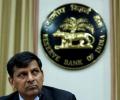
Here is some background on the candidates seen as potential successors to Rajan at the RBI

If this turns into reality, India's gross domestic product (GDP) growth will be the lowest since 2012-13, which could severely hit job creation and income growth in the near term.

As per the proposal, the banking sector deposits which have not been claimed for 10 years or more will be transfered to 'Depositor Education and Awareness Fund Scheme'.

RBI declines to accede to plea, upheld by Padmanabhan panel, for priority sector tag; feels move would dilute claims of those needing it more.

Governments that do not respect central banks' independence will sooner or later incur the wrath of the financial markets, ignite economic fires, and come to rue the day they undermined an important regulatory institution; their wiser counterparts who invest in central bank independence will enjoy lower costs of borrowing, the love of international investors, and longer life spans, said Acharya, who will return to the New York University's Stern Business School in August.
 © 2026 Rediff.com - Advertise with us - Disclaimer - Privacy Policy - Sitemap - Feedback - About us - Terms of use - Grievances